


 language
 Deutsch
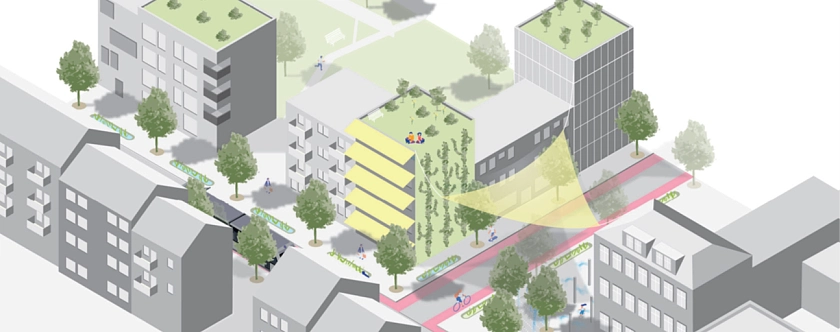
When it gets very warm in summer, cities heat up quickly. This is due, among other things, to the dense development in many places. So, it is very important in urban planning to take the effects of heat into account.
Bremen and Bremerhaven are developing projects and measures to deal with heat. The measures to adapt to heat waves go hand in hand with other measures for climate adaptation, such as those against heavy rain or flooding. The main aim is to reduce the effect of urban heat islands by cooling surfaces, creating shade and improving air circulation in the cities.
In short, the aim of modern urban planning is to make Bremen and Bremerhaven capable of dealing with extreme weather events and protecting their citizens from them.
The Heat Action Plan has its own field of action for climate-adapted urban development. The measures set out in it aim to adapt Bremen and Bremerhaven for coping with the effects of heat waves in the long term. These measures are also part of the Climate Adaptation Strategy 2025.
Public green spaces are important for the urban climate because they provide shade and cooling. At the same time, plants and trees are increasingly coming under stress themselves due to climate change. To ensure that the green spaces can withstand this stress and continue to fulfil their function as urban greenery, their care and maintenance will be adapted to counteract the effects of climate change. For example, plants that cope better with heat and drought are to be selected in the future, and irrigation is to become more efficient.
City trees provide shade and cool the environment by evaporating the absorbed water. They also store CO2 and thus contribute to climate protection. The goal is to increase the number of trees in Bremen and Bremerhaven. One focus is on the highly densely populated districts. To this end, suitable locations for trees are being sought where rainwater can also be retained in order to make it usable for watering the trees. Another measure for planting is to choose trees that can better cope with heat and drought stress. The irrigation of the trees will also be improved.
The aim is to redesign individual public squares and spaces so that they heat up less intensely. Enjoyment of spending time in these areas is thus improved and the public space becomes more attractive. The focus of the redesign is on nature-based solutions (shading, greening, unsealing, rainwater retention).
It must be ensured that public buildings such as schools and hospitals can continue to be used normally even during heat waves. Therefore, these buildings must be protected from heat. Appropriate renovation stops the rooms heating up too much in summer. Adaptation to heat in public buildings is particularly important, as vulnerable people are often present in these buildings. Prioritisation of the buildings will be undertaken as part of the measure.
Industrial estates often have a lot of sealed surfaces that heat up intensively. The heat from these small-scale heat islands can also have an impact on the adjacent urban areas. At the same time, industrial estates have great potential for adapting to heat and climate change. Flat roofs could be used as green roofs, for example. In Bremerhaven, experts are looking at which industrial estates are affected by heat and heavy rainfall and to what extent. An industrial estate management system, specially set up for the purpose, advises companies in Bremerhaven on measures for adaptation to climate change.
Municipal land-use planning determines how Bremen and Bremerhaven are to develop in terms of development. It therefore also determines where green spaces, parks and corridors for fresh air are preserved. This means that municipal land-use planning plays an important role in heat protection in urban development. Bremen and Bremerhaven each have their own municipal climate adaptation management to meet local needs. They integrate the concerns of heat protection into the processes of municipal land-use planning and make sure that sufficient green spaces, shading and cooling bodies of water are provided for during planning. The urban climate analysis and the “Climate Adaptation Check for Urban Planning” provide orientation to this end.
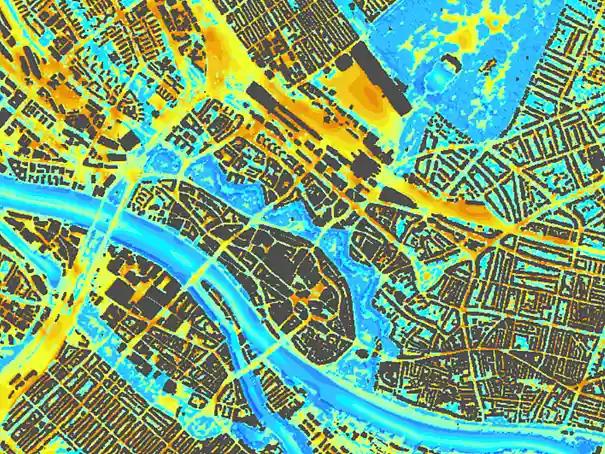
An urban climate analysis is available for both cities of Bremen and Bremerhaven. Urban climate analyses are a long-established tool for integrating climate as an important aspect in urban planning. They provide information on the importance of green spaces, wind and air currents and temperature distribution in the cities.
Bremen
Bremerhaven
Bremen and Bremerhaven have developed a Climate Adaptation Check 2.0: Guidelines for the Integration of Climate Adaptation Concerns in Urban Planning. The Climate Adaptation Check 2.0 provides orientation for urban planning. It contains questions on the concerns of heat protection and other topics of climate adaptation. The answers show planners and the municipal administration the extent to which planning takes aspects of climate adaptation into account. The Climate Adaptation Check 2.0 also contains planning information and orientation values for individual climate adaptation concerns.