

 language
 Deutsch
Due to climate change, the number of hot days is expected to increase in Bremen and Bremerhaven too. Climate modelling shows that heat waves will occur more frequently and at the same time last longer.
To describe heat development, we look at the number of hot days in the cities of Bremen and Bremerhaven over time. The so-called reference period serves as the basis for comparisons and statements on the development of heat. This means that an average value is formed from the number of hot days for the years 1961-1990. This average value is compared with current values in order to assess heat development.
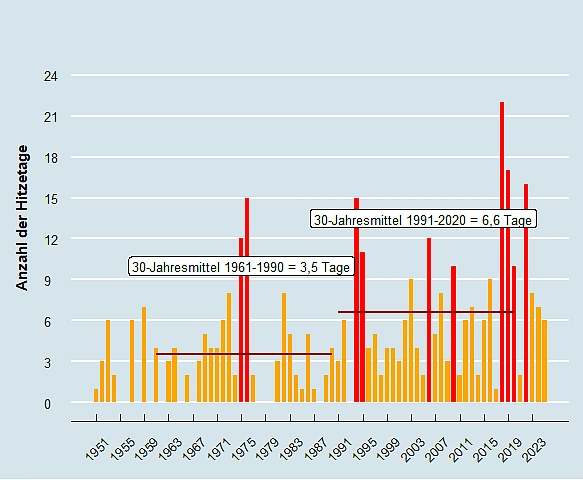
The diagram shows the number of hot days per year between 1951 and 2025 in the city of Bremen. Each column represents a year. The data is based on the measurement data from the weather station of the DWD at Bremen Airport (DWD, station 691). The red columns represent the ten years with the most hot days. Six of the ten years with the most hot days have occurred in the last 30 years.
The last decades show that hot days in Bremen have increased in number. The dark red cross lines show the 30-year averages. In the reference period 1961-1990, there were an average of 3.5 heat days per year. In the recent past, between 1991 and 2020, an average of 6.6 hot days occurred per year. Thus, the increase between these two 30-year periods is 3.1 days.
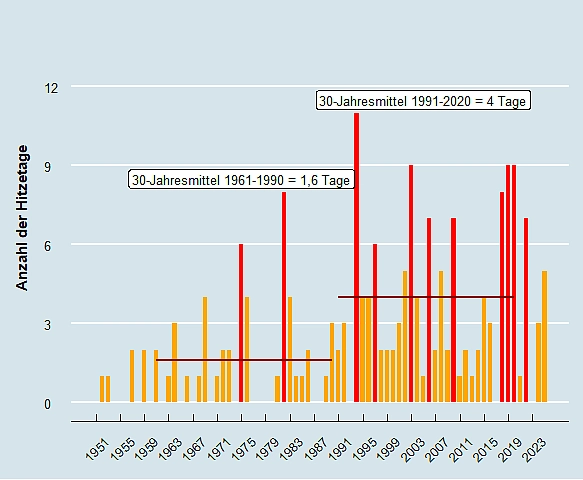
The diagram shows the number of hot days per year between 1951 and 2025 in Bremerhaven. Each column represents a year. The data is based on measurement data from the weather station of the DWD (station 701) in Bremerhaven.
The red columns represent the eleven years with the most hot days. Eight of the eleven years with the most hot days occurred in the last 30 years.
On average, 1.6 hot days per year occurred in the reference period. In the recent past, from 1991 to 2020, there were an average of 4 hot days per year. A comparison of the two periods shows an increase of 2.4 days per year.