

 language
 Deutsch
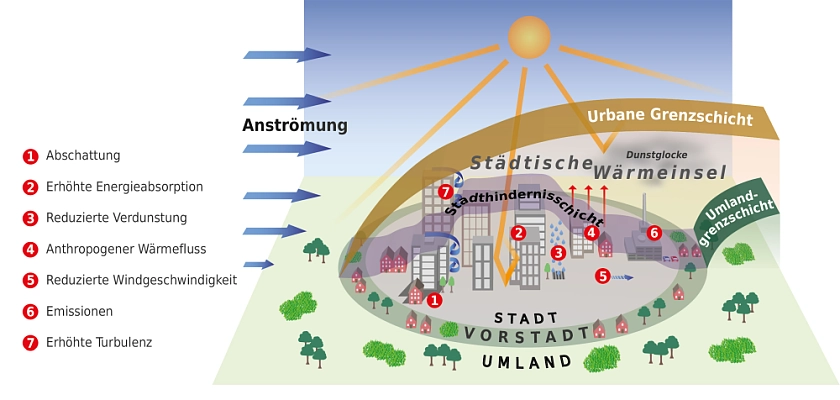
People living in cities are particularly affected by long-lasting heat waves, because cities heat up much more than the immediate rural environment. This warming is called the urban heat island effect. How does this happen?
Cities like Bremen and Bremerhaven are characterised by a lot of buildings and sealed surfaces. Roads, car parks, buildings, etc. – everywhere you look, the surfaces heat up under the sun’s rays and store this heat. At night, when it is cooler, the stored heat is released very slowly.
The dense development in cities also leads to poorer ventilation, making it more difficult for cold air from the surrounding area to flow into the city. This means that cold air can only cool urban areas down slowly, even at night or when the weather changes.
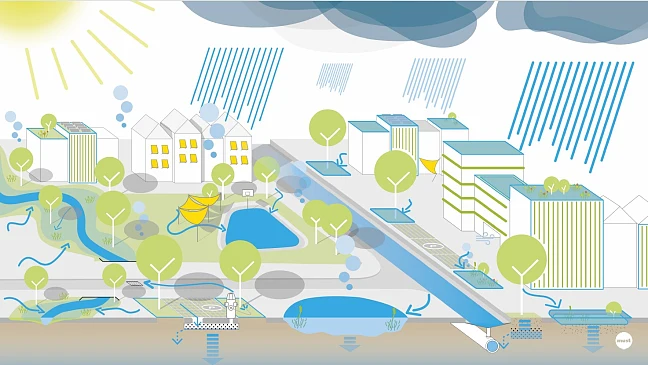
The effect of the urban heat island is intensified by the fact that precipitation cannot seep away on the sealed surfaces, so cooling due to the evaporation of precipitation is lost.
Cities also usually have fewer green areas and bodies of water, which also provide a cooling effect through evaporation. The smaller the proportion of green and water-covered areas in a district, the lesser the cooling effect.
Compared to other German cities, Bremen and Bremerhaven have comparatively high proportions of water-covered areas due to the Weser and the location on the North Sea. Both are also comparatively well ventilated, but an urban heat island effect occurs in both cities nevertheless.